Showing posts with label 80s. Show all posts

Sunday, 28 October 2012

Day 155 - twisted, but in a good way

I fancied a bit of old-school gaming this weekend, but then I remembered an e-mail I'd had earlier in the week from my Kickstarter account.  Giana Sisters: Twisted Dreams had been released!

I quite enjoyed the original Great Giana Sisters back in the day.  It was as close to Super Mario Bros. as I was ever going to get, and it helped usher in a new breed of platform game.  It was epic, it was fun, and it kept you playing in an attempt to find all the hidden secrets.  It still annoys me that my parents threw my copy away after I moved out of their house!

Poor cute Giana, having to get through this horrible land!
Anyway, I wrote about all this on Day 76, so I doubt you want to hear it again.  You probably want to know whether the new game lives up to its origins.  I'll give you my first impressions...

The first thing you notice is that Giana is beautiful.  Platform games aren't generally renowned for making your jaw drop with their looks, but this game is gorgeous.  In fact, it's doubly gorgeous, because each level has a completely different background, depending on which sister you're playing as.

Musically, it's also a bit of a treat, with both Chris Huelsbeck and Machinae Supremacy providing twists on the original's tunes, and again, these segue seamlessly between one or the other, depending on which sister you happen to be.

Aargh! What a nightmare for punky Giana!
This is exactly the same place as in the screenshot above. What a difference!
The gameplay is a little harder for me to comment on at this point.  It's still early days for me, for one thing... I still have a lot of ground to explore, and many features to discover.  Also, with the game looking as good as it does, it's not running all that quickly on the laptop I played it on.  I'll be putting it on my new laptop soon, though, and I expect that one to cope substantially better.  I expect I'll comment further then.

That said, it's good fun, and retains the tradition of the original Great Giana Sisters while taking it in a different direction.  As you'd expect, collecting diamonds is a large part of each level, although there are now three colours of the gems: blue, which either sister can collect; yellow, which only cute Giana can collect; and red, which only punky Giana can collect (wasn't she called Maria in the original?).

He's a big fella! Bet I'll have to beat him, somewhere down the line.
There are hidden areas to find, as you'd expect, and these are also found through twists on the original's gameplay.  For instance, in the first game, if you stood on bridges for too long, they dissolved away.  In this game, the bridges morph between broken and complete, depending on which persona's world you inhabit, and this helps you find your way to otherwise unreachable areas.

All the hard work and the stress of the Kickstarter appears to have paid off, with Black Forest Games having produced something which is more than worthy of the original's name, and which wears its old-school heart on its sleeve whilst having a really refreshing look and feel to it.  There's a lot of game here, which might eventually pale through lack of variety, but I'm very happy with the outcome and look forward to getting stuck into it properly.

Tuesday, 23 October 2012

Day 150 - 10,000!

I'm now five months into this project, and today I hit 10,000 page views.  I'll be honest, I'm pretty happy with that.  It's not like I've got any major backing from big websites or anything... there's just me spamming Facebook and Twitter, and website message boards that I was already a member of.  Who knows?  Maybe I'll ramp things up when there's more to talk about.

That said, I'll always appreciate any efforts my readers might want to make in plugging this.  The whole point of doing it is to attract readers, so the more I have the better.  I might even dish out rewards for anyone that gets me some good publicity... I've got about a dozen games on Steam, just waiting to be gifted (I will state that they're not current releases!).

Is there a more recognisable 80s' software house logo?
I will give a shout out to ex-Ocean graphics wiz Mark Jones, who's support of this project is much appreciated.  It's great to have people I intend to write about being so enthusiastic about this book, and quite important to me, too... it helps to validate what I'm doing, and lends it an air of authenticity.

Actually, if you're any kind of 8-bit computer fan, you ought to check out what Mark is doing to showcase Ocean's contribution to computer gaming.  The Ocean Software Facebook page constantly has new material posted, as does the Ocean Software website.  You'll find tons of fascinating pictures, storyboards and background there... it's really interesting.

Questions, questions... but who will I be questioning next?
What comes next, then?  What would you like to see?  I'm conscious of the fact that behind the scenes work isn't terribly interesting.  I'm trying hard to get a pool of stock questions for people, because I intend to send out a big batch of requests soon, but it's pointless doing that if I get a load of positive replies, only to sit there for ages trying to think of good questions!

Anyway, here's to the next 10,000 page views, the next 100 posts, and the next people who jump on board with me.  We're still looking at a great book here, the like of which is just not out there.  Let's get as many people on board as we can!

Sunday, 21 October 2012

Day 148 - Funkytown

It seems odd to be writing this just after saying how re-energised I am, but I've been in a bit of a funk lately.  I think part of that may be down to the fact that two of my biggest, most recent posts have been tributes to programmers that we have lost.  It's a blow to us all, to have these talents taken away, and it does put you in a bit of a down mood.

I've been perking myself up a bit through the medium of MAME.  When your mojo takes a hit, you can always rely on a good blast of arcade gaming to give it a shot in the arm.  I'm not saying they're necessarily better than the games I'm writing about for this book... just more immediate.

Something else I'm doing with old arcade games is making myself a big batch of ringtones.  I love messing around with stuff like that.  I first started out using bits of music tracks from my favourite artists, and then with bits of Commodore 64 tunes.  But it's much harder to make really good ringtones like that... they may be your favourite tunes, but they're not necessarily best-suited to the purpose.

Now, would any of these be good for texts?  No?
Well, there's another hundred or so to try.
Arcade sounds, on the other hand, are perfect.  Whether it's an "Insert Coin" sound effect or a game over jingle, there are a lot more sounds that are short, snappy and, well, ringtone-y.  So I've now got well over a hundred of the things that I can tailor to all manner of things.  I just find it great fun to play with things like that.

In other words, and connected to the start of my post, I've started reaching out to people who were connected to Gods that we have lost.  There's a number of people I would love to include in the book that sadly cannot speak for themselves, and while I'm able to write plenty about their games, I can't write much about the people themselves.  If I can include some personal tributes from those that knew or worked with them, it will be a nice touch, I feel.

Wednesday, 17 October 2012

Night has fallen... goodbye Mike Singleton, the Lord of Midnight

Man, this is getting quite upsetting... we're losing too many of our Gods.  News has reached me that legendary programmer Mike Singleton, author of bona fide classics The Lords of Midnight and Doomdark's Revenge, has passed away.

ZX Spectrum fans will be most familiar with Mike Singleton's work, and although it might not be a surprise to learn he started his games programming career in the days of the ZX81 and VIC-20, it might be more of a surprise to find he worked on games right up to Codemasters' recent racing thrill-fest, Race Driver: GRID.  He also appeared to be collaborating on a version of The Lords of Midnight for mobile platforms... let's hope the author still manages to get that released, it would be a fine tribute.


The Lords of... GRID-night?
Although he moved on to be responsible for a number of Amiga and ST classics, I'm going to concentrate on the games Mike released in the time period I'm writing about... the games he wrote for the Spectrum.

I'll be honest, because I only got to play on Spectrums in short bursts, I found myself baffled by The Lords of Midnight and Doomdark's Revenge.  They were far, far deeper than anything I'd ever encountered up to that point... I was all about arcade games.  It was after I'd been hooked by The Bard's Tale on the Commodore 64 that I went back to them, playing the C64 conversions.  I can't lay claim to having beaten the games, but I did learn to appreciate and enjoy them quite a bit.  But they weren't Mike Singleton's only games... I'm going to start with the 16K games.

Shadowfax

When someone writes a game named after Gandalf's horse, you know immediately where they're coming from.  Having said that, with only 16K to work with you couldn't be expecting a Lord of the Rings-style epic.  What you get is a game that reminds me of Stampede on the Atari 2600.  Riding your beautifully-animated white horse from right to left, you must fire lightning bolts at the hordes of Sauron's dread riders.  And... that's it.  A high score is your reward for surviving for as long as possible.  It's simplistic arcade fun, and an innocuous start to a storied career.


Ride, my beauty... ride like the wind!
Siege

Taking on a more traditional military theme, Siege sees you atop a particularly high wall, which is being scaled by a seemingly-infinite army.  Luckily, you have a seemingly-infinite supply or projectiles to drop on them, knocking them from the wall.  It reminds me, oddly, of Kaboom! on the Atari, except you get to be at the top of the wall rather than at the bottom doing the catching.  Again, it's simple, but it's pretty good fun.


This isn't going to end well...
Snake Pit

A cross between Snake and PacMan, Snake Pit sees you as a yellow circular thing with a big mouth, who likes nothing more than eating eggs.  The trouble is, once you start eating eggs, you free some big, horrible snakes, and they like eating yellow circular things with big mouths.  A bit of a problem, that.  On the other hand, if you eat all the eggs, you then get to try and eat the snakes, so it's not all bad.  It's OK for what it is, and probably went down really well on the 16K machine at the time.


Snakes.  Why did it have to be snakes?
3-Deep Space

I thought that this was a straightforward space shoot 'em up with fiddly controls, until I did a bit of research, which revealed that this actually was, literally, a 3D shooter!  That explained a lot!  That being the case, I couldn't really give it a proper go, as you need 3D glasses to see exactly what you're doing... the ships move on a 3D plane, so you can only destroy them if you're on the same plane.  It's a pretty ambitious and innovative effort in that case, but one I can't really comment on properly.


I bet this looks better through funny glasses.
The Lords of Midnight

Nothing that Mike Singleton had previously done had given any indication as to what would be next.  You just couldn't imagine that someone who had programmed some fairly simple-but-enjoyable arcade-style games would suddenly come out with one of the most epic strategy-cum-adventure-cum-fantasy war games that had ever been seen.  Indeed, the combination of genres made The Lords of Midnight one of the most original games available in its time.


Luxor the Moonprince... the original pensive hero.
Intended as the first of a trilogy, this is not a game to play when you have a few minutes spare, although it's possible you can lose in minutes when you first start out.  But even after a few hours, you've only just begun to scratch the surface.

The object of the game is to take Prince Luxor and defeat the Wichking, Doomdark, who is threatening to seize complete control of the Lands of Midnight.  As you would expect of someone who is a Witchking, Doomdark is quite evil and has a huge force at his disposal.  But evil will always be opposed, and there are characters all across the land who may be willing to help Luxor in his quest... if you can find them.


This doesn't look good.  Do you think if I get a round in they'll be OK?


Fortunately, Luxor has three allies from the beginning, and you can also control them in your attempt to destroy Doomdark and his armies.

Once you begin, you start to realise just how impressive the scope of this game is.  For a start, the story, although heavily inspired by Lord of the Rings, is very well fleshed-out.  The number of unique characters you encounter is also surprisingly large, and given that you can send any or all of your four initial characters in any direction and in any combination right from the beginning, it could take you a long, long time before you encounter them all.


Rorthron the Wise is also Rorthron the Deadly, it seems...
For all that, though, you never feel as though you're stuck in a boring trudge across the landscape.  You always feel as though you're part of something epic, and that danger and evil is lurking around every corner.  And with two distinct ways of completing the game, the longevity is guaranteed.  The Lords of Midnight has inspired countless games, and is rightly regarded as a classic.

Doomdark's Revenge

How do you follow a game like The Lords of Midnight?  How about with a sequel that is bigger, more involved and which addresses any small issues that the original may have had?  That always sounds like a good idea, and so it was that Mike Singleton released Doomdark's Revenge.

He's back, and still awesome. As a side-note, the only time I ever played D&D, my
character was called Luxor.  Bastard DM killed him off within an hour of starting.
With Doomdark beaten, the Lands of Midnight are peaceful again... or so everyone thinks.  What they didn't take into account was that Doomdark the Witchking had a daughter... Shareth the Heartstealer.  And she is now consumed by anger and fury... not that her father is dead, but that someone else killed him before she could.  That's how you know she's especially evil, and that trouble is just around the corner...

Doomdark's Revenge sees you travelling to the Lands of Icemark, where Shareth dwells.  The quest is larger, more epic and more involved, for you are not just attempting to destroy Shareth, but also to find Luxor's son, Morkin, who has been spirited away by the evil Heartstealer.


Tarithel is attempting to win back her love, who was taken by Shareth.
A showdown at the end could be the 8-bit equivalent of female jelly wrestling.
This time around there are more commands at your disposal, and it seems slightly more user-friendly.  The map is quite a.bit bigger than in Lords of Midnight, but consequently seems less inhabited.  I suppose you might expect that, especially in a land called Icemark, but in games like this you actually like bumping into things.

Special mention must go to the superb packaging of these games.  The artwork is striking and excellent, and the inclusion of the novellas with the instructions really helps to set the scene and get the story across.


"Luxor is not at all despondent".
He obviously wasn't planning to watch Poland v England on Tuesday night.
Doomdark's Revenge is certainly a worthy sequel to The Lords of Midnight, and a great game in its own right.  It will forever remain our loss that we will not see The Eye of the Moon, and the conclusion of the trilogy

Throne of Fire

This game was designed by Mike Singleton, but apparently not programmed by him.  I'm sure there's a story behind that, maybe I'll be able to find out.  There's a story behind the game too, and it's typically involved.

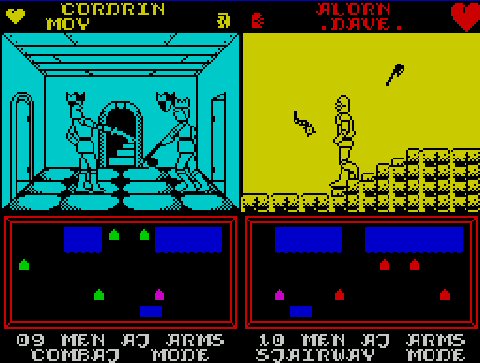
King Atherik is dead, and the Throne of Fire is empty.  Atherik had three sons: Alorn, the Lion Prince; Cordrin, the Sun Prince; and Karag, the Wolf Prince.  Only one of these sons can take over the Throne... but the condition is that whoever takes the Throne must be the last one alive.  So begins a cat-and-mouse hunt throughout the castle, with ultimate rule being the prize, and death awaiting the losers!


Avast, ye varlet!  Oh wait, that's pirates, isn't it?
This is a very novel premise, and I'm not sure if I've ever seen it repeated, although I suppose it is a little like the forefather of the deathmatch, as it is possible to play a two-player game using the split-screen.  The castle interior is displayed on a map at the bottom of the screen, but you can only see a small part of it at a time.  Handily, it shows you which rooms are occupied, and by which Prince's men, so you always know whether you're going to be in a fight or not.

Sadly, the fighting is the least satisfying part of the game.  All that happens is you walk into a room with an enemy, the two characters waggle their weapons at each other, and one of them vanishes.  There's no feel involved, no feedback or even any real idea if you're winning or losing.  I don't know if it would have been difficult to implement some kind of energy system (besides the beating heart at the top of the screen), but it would have helped.


And with that, my dreams of being King are over.
That said, it's still a fun game and the allure of becoming King is strong.  With a little bit of tweaking, Throne of Fire could have been a classic.  As it is, it's "merely" a fairly entertaining romp.

Dark Sceptre

I will always remember the first time I saw Dark Sceptre in Crash magazine.  I couldn't believe my eyes.  The characters were huge!  And it looked like a fighting game... it had to be awesome!


Harry was late for his Ku Klux Klan initiation.
Of course, being a Mike Singleton game, it isn't really a fighting game at all.  It is, in fact, a very strategic game where although the characters fight, you don't personally swing a single sword in anger.  Instead, you're like the supreme commander, and you issue orders to your legion who will do their best to carry out your will.

The story goes that the Northlanders, their ships battered by wild seas, ended up at the Islands of the Western Sea.  Generously, the Lord of the Isles offered them shelter through the winter, and strong ships for their journey home when spring arrived.


The list of commands, as you can see, is quite extensive.
The Northlanders, though, chose not to leave, demanding land to make their homes.  The Lord of the Isles was not pleased, and fashioned a magical Dark Sceptre with which he planned to drive out the Northlanders.  The plan went awry when the Sceptre gave the Northlanders a terrible power, and turned them into Lords of Shadow.  The Sceptre would have to be destroyed to rid the Isles of this evil.

Dark Sceptre is not a fast, action-packed game.  Far from it.  But it's really quite compelling.  Choosing one of your characters, giving him a series of commands and then watching him stalk the landscape, attempting to carry them out, is compulsive stuff.  I found myself really intrigued as each of my warriors went to do battle with the Lords of Shadow.


Go on, son.  Get stuck in!
As you would expect, you're not going to beat this game quickly.  In fact, it takes a lot of planning and experimentation to get anywhere at all.  It will take weeks of in-game time to drive out the Northlanders, and it's not something that will be to everyone's taste.  Personally, I was easily interested enough to persevere, and I want to play it again even now.

War in Middle Earth

After all the games that were inspired by The Lord of the Rings, it was inevitable that there would eventually be a game based directly on The Lord of the Rings.  The only surprise is that Mike Singleton didn't actually design the game he programmed.

What isn't a surprise is that War in Middle Earth is an epic war game.  How could it be anything else?  The object of the game is to... oh, come on.  Really?  You must know this by now.  Oh, alright... the evil Sauron has lost his ring of power, and he wants it back.  The ring has found its way to the unlikeliest of owners, the unassuming Hobbit, Frodo.  An allegiance is made between all the races of Middle Earth, and a quest to Mount Doom to destroy the ring is undertaken.  It must be successful... Middle Earth depends upon it.


If only Peter Jackson had done the graphics...
The game displays a map of the whole of Middle Earth.  Highlighted on it are various factions, and you have a gloved hand at your disposal with which you can select any of these, or just magnify any part of the land if you want.

This is where your strategy comes into play.  You must move your "pieces" into place so that you can counter Sauron's forces.  You choose each unit, give them an order, then select the "Time" button, and everyone will begin to move accordingly.  Sauron's armies will also move at this point, so you must hope that your moves are strong enough to counter his, and that eventually you can drop the ring into Mount Doom, thus destroying it and returning peace to the land.


I'm not sure about that Frodo.  He doesn't seem determined enough for this task.
As quests go, there aren't many more epic than this one.  There's an enormous amount of game here for those that are strategically-inclined, and it will no doubt take months to achieve a successful outcome.  For me, personally, it's a strategy game too far.  It's just a bit much for my meagre brain to grasp, and though I struggled manfully with it I didn't get anywhere.  Anyone with a penchant for controlling armies and a love of little men with big hairy feet, though, would have no doubt loved War in Middle Earth.

There were other games, of course, on other systems, with various degrees of involvement.  The Midwinter games, especially, are highly renowned.  For Spectrum owners in particular, though, the legacy of great games is as strong as that of anyone you could care to mention.

I had hoped to talk to Mike Singleton about the games I've written about and his Eighties' programming days.  Indeed, I'd recently sent an email to someone asking if it might be possible.  Sadly, I didn't even realise he was ill, and it was not to be, but I will certainly be featuring his works in my book, and would love to include quotes in tribute from those that knew and worked with him, or were inspired by him.

We, as creatures, are not on this planet for long.  It's important to try and leave our own mark on it, in some way, while we are here.  Mike Singleton has left an enormous, indelible mark, one that has inspired generations and will no doubt continue to do so.  He will be sadly missed.

Sunday, 16 September 2012

Day 113 - U.S. Gold

The north-east of England was invaded by the might of the United States of America last week, as they dragged us into a more civilised world with the opening of a massive Krispy Kreme doughnut and coffee shop.


Mmmm... delicious, glazed, doughnutty goodness!
Oh, what?  You thought this post would be about games?  Sorry!  Well, I'll see if I can squeeze some in while I'm here...

When you think about U.S. Gold, you think of a meganormous American company shipping their exotic foreign wares to a grateful British gaming public.  In truth, it wasn't exactly like that.  True, they did produce or publish some amazing stuff, but they also put out more than their fair share of dross, particularly in the early days.

Interestingly, several of their better games, particularly in later years, were programmed by British coders.  One of my favourite U.S. Gold games was Archer MacLean's Dropzone.  That wasn't always the case...

These are the things that will be killing you now.
I first played Dropzone at a mate's house.  I didn't particularly want to, after I'd seen him play it.  Clearly, it was a Defender variant... and I hated Defender, on the grounds that I was rubbish at it.  Still, I gave Dropzone a go... and I was rubbish at that, as well.  It was soul-destroyingly difficult.  Not to worry, I didn't need to play it any more, I had plenty of other games to be getting on with and it wasn't like I owned it or anything.

Then, one fateful day, I was walking around Newcastle with ten pounds to burn.  There was no question in my mind that it would be spent on a game (or some games)... the only question was which game?

I'm so busy, my head is spinning...
It was then that I saw a compilation on the shop shelf... U.S. Gold's Arcade Hall of Fame.  It looked amazing.  Spy Hunter... Tapper... Up 'N' Down... Aztec Challenge... Blue Max.  I'd played all of them before, and the only one I didn't love was Blue Max.  Better still, I didn't own any of them.  It was a must-buy for £9.99.

I had a great time when I got home, loading them up one at a time for an evening of cracking entertainment.  Spy Hunter, Tapper and Up 'N' Down were all excellent arcade conversions.  Aztec Challenge was great fun with excellent music (although if you've ever tried to play it on a black and white telly, you'll know that there's a problem that effectively renders you blind on one of the levels).

It's the end of the world as we know it.
Blue Max was the last game I went to load, because I hadn't much liked it when I played it and so wasn't really bothered about it.  I hit Shift and Run/Stop, pressed Play on tape and started reading the instructions.  I missed the "FOUND" message, but looked up when I heard the familiar screech of the Novaload... whereupon I was dismayed to see the word DROPZONE in the middle of the grey screen.

I didn't even know how this could be.  I mean, I knew I wasn't exactly excited by the prospect of Blue Max, but Dropzone wasn't even supposed to be in this compilation!  Why would they replace Blue Max with that, of all games?  Damn them!

I played it a few times, and only broke the 10,000 barrier once or twice.  It was so hard and I hated it.  I vowed never to play it again.

Some things never change...
But over time I kept reading about how it was a modern classic, and one of the best games ever, and how everyone loved it.  As someone who considered myself a pretty decent gamer, I figured I owed it to myself, and the game, to give it one more shot.

Slowly, with intense concentration, I began to improve.  I reached 20,000, then 30,000... and I found myself enjoying the game.  With the computer on the floor, my left foot on the Commodore key for my invisibility cloak and my right foot on the space bar for the smart bomb, I had a set-up which was comfortable and saw me making decent progress.  And I saw the game for what it really was... an incredibly challenging shoot 'em up which ranked up there with the very best.


Foot, meet face.
I think my high score on Dropzone was about 153,000.  That's not amazing by any stretch, but it's not bad and it shows that I made a more than reasonable effort at learning the game.  I still enjoy it to this day... it's probably Archer MacLean's best game, although the superb International Karate runs it close.  It would be great if I could get a few quotes from Archer in my book, and it goes without saying I'll be including him and his games regardless.

Sunday, 2 September 2012

Day 99 - Set myself a Task

I'm sure you've noticed my posting has slowed down of late.  There are a few reasons for that.  Real-world stuff has reared its ugly head again, with me having to get my eldest prepared for going back to school this coming week... he's at a new school, and it's ridiculous how much stuff I've had to buy.  I sense another eBay purge in my near future...

Another reason is one I've been both hoping for and dreading at the same time.  I've got through to the next stage of both the jobs I applied for recently, one of which means I have to have an interview.  I've never liked interviews, and it's been fifteen years since I had one.  So I have to prepare really thoroughly for this one.  It's quite important, so I might well be less evident here until it's out of the way.


Pew! Pew! Shoot the little saucer things from your giant Gyro thing!
With that being said, I have to have the odd respite from all that, and this is where games come in to save the day, yet again.  I delved into the depths of my mind, and pulled out the name of one of the more charming software houses, and one who really only existed in the early-ish days of the 8-bit computers... Taskset.

One of my mates had a few of their games before I even owned my Commodore 64 and they were quite distinctive and fun to play, although not many of them would stand out as classics.  They were colourful, with very big, mostly chunky graphics, and an immediately recognisable music style.

Some of their games could only have come from the minds of the British.  Take Bozo's Night Out, for example.  The object of the game was to get Bozo home after an epic night on the lash.  This, of course, is much easier said than done.


Yep, this has all the makings of a good night out.
Bozo is a chunky-looking bloke... and not in a good way.  This doesn't help when he's staggering about after a skinful.  Nor does the fact Bozo has many obstacles to overcome in his quest to sleep it off.  As if avoiding cops, skinheads and, ummm, naked women (?) wasn't bad enough, attempting to take a shortcut through the park sees Bozo bumping into all kinds of horrors.

It's mental stuff, and not all that good in the cold light of day, but back in the day it was entertaining stuff.

Another Taskset game that you wouldn't get from any other nation was Seaside Special.  Borne from the legacy of the seaside postcard but imbued with a British sense of satire, the game saw you trawling a beach for radioactive seaweed, with which you then trooped off to 10 Downing Street to lob at the sackless political residents.


Even Tebbit would be crapping himself at the sight of that stripey loon!
To be fair, it sounds a lot better than it actually was.  Every aspect of the game was simplistic, but again, it was a bit of a laugh to play back in the day... for a while, at least.

All this does make it sound as though Taskset were a bit of a novelty company, who were only there to make up the software numbers at the beginning of the 8-bit revolution.  There were, however, two stone-cold classics in the Taskset lineup... Super Pipeline, and its sequel, Super Pipeline II.

The object of both games is to guide your plumber and his mates around a series of pipes, keeping them open so that the water (or whatever liquid it is) can flow into the barrels at the end.  This sounds easy, but as you would expect, there are a number of obstacles which attempt to make things run far from smoothly...


You know, this would be a lot easier if they built a pipe
that went straight to the barrel.
Rogue tools will make holes in the pipes, and these will need to be fixed.  That's where your mates come in... they're skilled at pipe fixing.  While they're at work, you have to fend off anything that might drag them from the pipes.  And I do mean anything... besides the roving tools, insects and lobsters wander about, and they will drag you and your pals from the pipes at every opportunity.

The Super Pipeline games are frantic, cartoony and great fun to play.  They were unquestionably the jewels in the Taskset crown, and kept me amused for many a long while.  It's a shame that the company died out as things were really taking off with computer and video games... Andy Walker was their key man, maybe I'll get to hear some of his and their story in weeks to come.

Monday, 27 August 2012

Day 93 - the objects of my affection

One of the great things about the British is our love for the absurd.  We can take anything, no matter how ridiculous, and fashion it into something not just acceptable, but ground-breaking.  Take Monty Python's Flying Circus, for example.  A lot of their comedy sketches were bizarre, and a fair number of them didn't work in hindsight, but they were embraced the world over and are still revered today.  British computer games used to be like that.

If you consider today's multi-mega-million dollar industry, it's all about the lowest common denominator.  Make a product that ticks all the boxes for the masses, and it's a go.  It's much trickier to get backing if you have a brand-new, off-the-wall idea.  That's probably why indie games are having such a resurgence.


Attack of the Mutant Camels... on my iPhone.
Pity the controls are rubbish (not Jeff Minter's fault!).
If British games in the Eighties had to go through the same sort of committee approval as they do now, then we wouldn't have had much to choose from.  It's fair to say that a decent number of them were quite mental.  With talented, often maverick individuals holed up in their bedrooms or tiny offices with little to reference other than arcade games, any subject was fair game, and nobody thought anything of it.

This was great, and led to some incredibly imaginative, unique games.  And in the grand spirit of Monty Python, some of the adversaries we had to contend with, or some of the protagonists we played as, were about as unlikely as you can get.  I thought I'd look at a few.


Even if you've never watched Monty Python, this might look familiar...
Miner Willy was one of the first true gaming icons.  Playing as a miner isn't necessarily that odd... it's just another human character.  But Matthew Smith put the poor fella in some real nightmare scenarios.

Both Manic Miner and Jet Set Willy are legendary names in the world of gaming.  And although at their core they are simple platform games, each is blessed with the twisted heart of an evil genius.  The games, that is... I'm not saying that Matthew Smith is evil, although I will level the charge of genius at him.


I need a wee, but I think I'd be better off holding it in...
When Willy starts exploring the abandoned mine in Manic Miner, it doesn't seem that odd... OK, so finding penguins in a long-lost cavern underneath London is a bit mental, but you can run with that.  It's when you find yourself having to leap over animated toilets, their lids flapping wildly and angrily, that you realise something darker is at work here.  Vicious telephones only serve to compound the bizarre nature of the dangers at hand.

That darkness was expanded upon with the sequel, Jet Set Willy.  Doing what all good sequels should, it increased the size and scope of the game massively, and threw far more off-the-wall enemies and situations your way.  Forced by your maid to tidy up your mansion after an epic party if you want to sleep it off, you find there's far more to this abode than meets the eye.


What in the name of all things Holy is that thing?  And why is it in my house?
Chainsaws, spinning razor blades, secateurs and ice creams are all out to get you this time, but that's only the half of it.  Nightmare visions await, with mad chefs, dancing rabbits and scary floating heads which will freak you out, and if they don't, well, there's always the room that turns you into a flying pig...

It's heady stuff, to be honest.  The design, whether intentional or accidental, is such that you're compelled to keep playing after yet another irritating death.  And, as with many games of this type, you want to keep exploring so you can see what's around the next corner.  It's a template that was followed for quite a while, until platform games grew up a bit and started being either cartoony or a bit more realistic.  For a couple of years, though, they were gloriously... manic.


Something tells me that alcohol wasn't the only thing ingested at this party...
Another gaming legend that refused to bow to the norm, whatever the norm may have been back then, is Jeff Minter.  You might have gathered as much from the moment you saw his company was called Llamasoft, although strictly speaking, maybe it should be called Ungulatesoft, as no hooved animal is left unloved by the Yak.  Attacks by mutant camels, deep-space sheep and. erm, lawnmowing are just some of the unconventional situations you'll find in his games.

Possibly his finest example of beast/object cross-pollination, though, is Ancipital.  Playing the role of Cippy, an anthropomorphic goat-like creature from an unnamed planet far away, wasn't enough, as far as Jeff Minter was concerned.


A 'No Smoking' sign on a cigarette break? Is that ironic, or not?
You found yourself trapped in a 100-room complex where you were asaulted by all kinds of common-or-garden earthly objects.  Apples, boots, hammers, spanners, hamsters, floppy disks... all these and more roam the complex, looking to bring an end to the invading critters.  Better still, you returned fire with a range of equally mundane yet appropriate objects, almost antidotes in fact, such as bananas, washers and cassette tapes.

Ancipital is an excellent game, and provides a ton of entertainment even today.  I'm of the opinion that it would make a superb iOS game... let's hope that Jeff Minter has similar thoughts.

David and Richard Darling formed Codemasters, who are now renowned for producing some of the fastest and flashiest current-gen racing games.  But they didn't start out like that.  They started out as an 8-bit budget game label, selling games with the word Simulator in the title for £1.99 a pop.  That was relatively successful for them, but things really took off when they published a series of games which put you in control of... an egg.


Like a whirlpool, it never ends...
Dizzy was its name, and it had arms and legs, and a big smiley face.  It jumped and flipped and rolled its way around a variety of landscapes, searching for the correct items to use in the correct places.  More of an arcade adventure than a platform game, it had been done before, but thanks to Andrew and Philip Oliver's eggy vision, Dizzy really popularised the genre and gave it legs, so to speak.  Six sequels were testament to the egg's popularity, and even today, people clamour for a new game.  I doubt that a game starring an egg would get greenlit today, even at Codemasters, although with the way the iPhone market is going these days, who knows?

Who remembers Fat Worm Blows A Sparky?  No, it wasn't Ron Jeremy's first gay porn film.  It's actually an ingenious game where you controlled a worm that was stuck inside your ZX Spectrum.  The object of the game was to collect fifty items called Spindles, then find a disk drive and clone yourself.  Unfortunately, roaming around inside the Speccy were Creepers and Crawlers, and if these bugs managed to pounce on Fat Worm then eventually he would perish.  His only defence was to fire Sparkies at the bugs.


Hope there aren't any seagulls inside this Spectrum...
You what?  If you pitched that now, you'd be laughed out of the room.  And yet, back in November 1986, CRASH gave it a massive 95% score.  It really was quite an achievement for its day.  Of course, this wouldn't be the last time worms would play an integral part in a game...

There were many others, of course.  Monty on the Run featured a mole versus a whole host of marauding household objects.  Fox Fights Back saw you playing as a gun-toting fox, defending himself against the likes of cycling beagles, mad squirrel bombers and egg-chucking chickens.


To progress, you must get past the flying clock and roaming teapot.  Naturally.
Even an early game like Casey Jones, a clone of Moon Patrol, Britished the whole thing up by putting you in a train rather than a moon buggy, and had you attacked by flying burgers, Horaces going skiing, and rogue Melbourne Houses (did the author have a game rejected by them or something?  Maybe I'll get to ask!).


We all love a bit of Horace. There's something not quite right about this, though.
This led to many early computer games feeling slightly amateurish, but that's because they were.  They were also very endearing, with a charm that was lost when games became soldier versus soldier, space marine versus space marine.  And while there's no arguing that current mega-budget games are polished to the nth degree, finely-honed, slick and ultra-professional, you can't help but wish that someone would throw in a daft gun that fired bananas, or something.


The quick brown fox can't outrun the lazy dog on a bike.
That's why he's carrying a shotgun.
I think a large part of the reason household objects played such a part in early games was the 'one man band' factor.  It's quite likely that a number of programmers in the early days could make a game, but were not graphic artists, and so used characters that you would see in every day life and which were easy to draw.  As games, and the process of making them, grew more sophisticated, you saw dedicated graphic artists producing stunning works of art and some great sprites and characters.

This was an important step in the evolution of video games... they would never be quite the same again.  It's something I'm planning to talk about in the book to a degree, with comments from programmers and dedicated graphic artists hopefully providing some interesting insight.  It'll certainly be interesting to me... I'm absolutely terrible at drawing!